
Emptier Cartons, Fuller Invoices: Inflation”s Quiet Accomplice Goes to Work
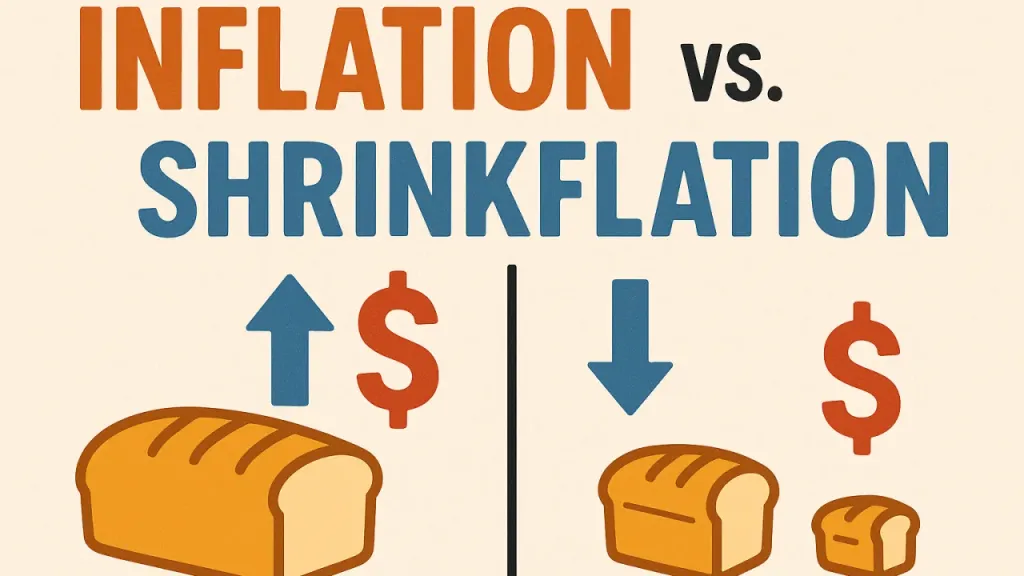
For a brief stretch, it looked as though the inflation crisis was finally behind us. That hope has faded. As of mid-2026, prices are climbing again, and a quieter companion to inflation, the steady shrinking of the products we buy, is compounding the pressure on household budgets in ways the official numbers struggle to capture. Together, they form a pincer movement that is making everyday life measurably more expensive.
Start with the headline figure, which has turned sharply in the wrong direction. The US inflation rate stood at 4.2 percent as of May 2026, and that reading was no blip. It marked the highest level since April 2023 and the third consecutive monthly acceleration in headline inflation. The primary culprit has been energy. Energy costs jumped 23.5 percent year over year, with gasoline prices soaring more than 40 percent, driven by the energy shock triggered by the conflict with Iran. Crucially, the pressure is no longer confined to the gas pump: inflation also accelerated for shelter, which rose 3.4 percent, and food, which climbed to 3.1 percent.
This resurgence matters because it reverses what had been a steady cooling trend. Just a couple of months earlier, the annual rate sat at 3.3 percent in March before climbing to 3.8 percent in April and then 4.2 percent in May. Even the Federal Reserve's preferred gauge has moved higher, with core PCE rising at a 3.4 percent annual rate in May, well above the central bank's 2 percent target. For households already stretched thin, the renewed climb feels less like a statistic and more like a monthly erosion of purchasing power.
Yet the official inflation rate tells only part of the story. The second, sneakier force is shrinkflation, the practice of reducing a product's size while holding its price steady. Product downsizing occurs when an item's quantity decreases without a matching price drop, which raises the per-unit cost and quietly contributes to inflation. The classic illustration is disarmingly simple: a pint of ice cream that was once 16 fluid ounces might now be 14. Because the packaging often looks nearly identical, the change is easy to miss and easy to forget.
The recent examples are striking in their specificity. Dawn Platinum dish soap shrank from 32 ounces to 30, Febreze spray cans dropped from 8.8 ounces to 8.1, Smucker's strawberry jam lost two ounces per jar down to 30, and Kellogg's Corn Pops fell from 18.1 ounces to 16.4. Even bulk warehouse brands are not exempt: Costco's Kirkland fabric softener dropped from 187 ounces and 276 loads to 150 ounces and 257 loads. A related tactic, sometimes called skimpflation, swaps cheaper ingredients into trusted products, as seen in newer Reese's items that quietly replaced real milk chocolate and peanut butter with vegetable and hydrogenated oils.
What makes shrinkflation so effective is the psychology behind it. Studies have found that consumers are less likely to react to downsizing than to outright price increases, meaning people keep buying coffee and paper towels even after the package shrinks. Manufacturers know this, and they exploit it: a company may calculate that a per-unit price increase will hurt sales far less if it arrives disguised as a smaller size rather than a higher sticker. The cost to consumers is real even when invisible. Among downsized products, the per-unit price increase has ranged from roughly 12 percent for paper towels to 32 percent for coffee.
There is an important nuance worth stating plainly: economists are divided on how much shrinkflation actually moves the broader inflation needle. Government analysis found that downsizing had a minimal impact on overall inflation from 2019 to 2024, because downsized items make up a small share of tracked spending and many big-ticket costs like housing cannot be shrunk. One academic study went further, distinguishing true shrinkflation from the gradual introduction of smaller products, and found that fewer than half a percent of products fit the strict definition of a continuing item being downsized. But that same research also showed the cumulative effect is far from trivial: the average size of packaged food declined by nearly 15 percent between 2012 and 2019, adding close to four percentage points to measured food inflation.
The burden, moreover, does not fall evenly. Shrinkflation amounts to a hidden redistribution of value from consumers to companies, one that lands hardest on lower-income households. Concern is widespread and growing: a recent survey found that 80 percent of adults were very or fairly concerned about shrinkflation, up from 75 percent two years earlier. And in a twist that benefits manufacturers, research suggests that when package sizes shrink, consumers often respond by buying additional units, increasing their overall spending over time.
For now, the path forward for consumers is mostly defensive. The most reliable safeguard is to ignore the front of the package and focus on the unit price, the cost per ounce or per sheet, which strips away the marketing and reveals what is actually being paid. Policymakers are weighing more structural fixes, including mandatory unit-pricing laws and labels that would flag when a product has been downsized, though only a handful of states currently require such disclosures. Until those protections become widespread, the burden of vigilance rests squarely on the shopper. The cartons may be getting emptier, but the need to read them closely has never been greater.