
Orascom Investment Under Pressure From the Cost of Capital: Samer Choucair Looks Beyond the Losses and the Challenge of Reallocating Assets
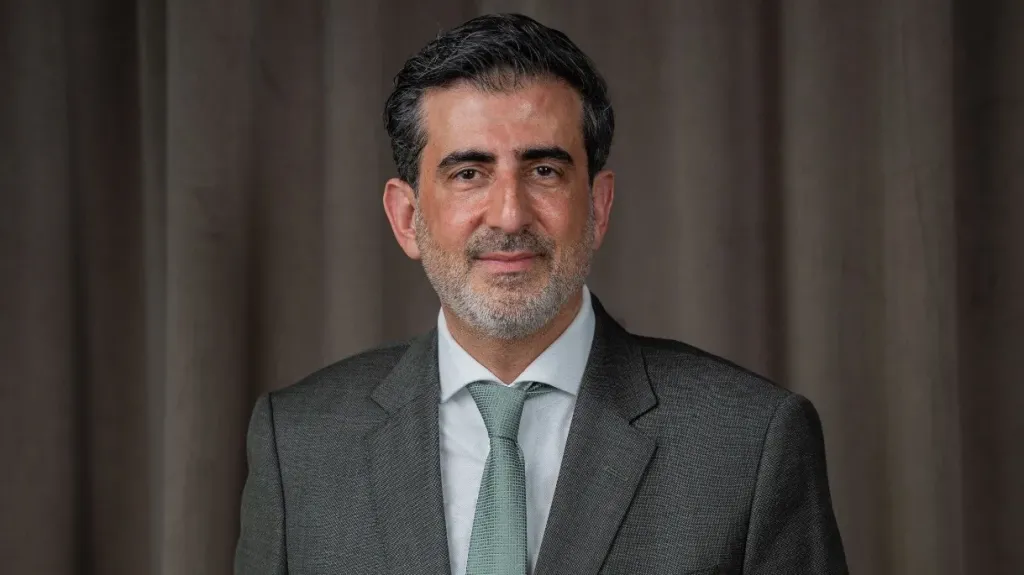
Investment leader Samer Choucair said Orascom Investment Holding has entered a more sensitive stage in its transformation from a telecommunications-focused group into a diversified investment company, after its 2025 results showed widening losses despite a substantial increase in revenue. He explained that the real test is no longer the size of sales, but whether the underlying assets can generate cash flows sufficient to cover financing costs and deliver sustainable returns on capital.
Choucair noted that the company’s standalone net loss reached approximately EGP 533.8 million in 2025, compared with EGP 450 million in 2024. Meanwhile, consolidated losses attributable to shareholders of the parent company reached around EGP 518.4 million, up 13.8%, while consolidated revenue surged to approximately EGP 1.39 billion from EGP 481 million.
The increase in revenue was driven primarily by the consolidation of Misr for Entertainment Investments, which contributed around EGP 943.5 million in restaurant and hospitality revenue.
Revenue Growth Alone Is Not Enough
Samer Choucair said Misr for Entertainment Investments was valued at approximately EGP 502 million as part of an acquisition structure that included assets such as Abla Masr, Pier 88, tourism operations, and restaurant businesses.
He said diversification has reduced Orascom’s dependence on its telecommunications legacy, but stressed the importance of distinguishing acquisition-driven growth from organic growth and evaluating transactions through margins, cash generation, and return on invested capital rather than headline revenue alone.
Choucair pointed out that the company has now recorded three consecutive years of standalone losses, rising from approximately EGP 185 million in 2023 to EGP 450 million in 2024 and EGP 533.8 million in 2025, following profits in 2021 and 2022.
At the same time, he noted an improvement in standalone operating performance during 2025, suggesting that a significant proportion of the pressure came below the operating line, particularly from financing costs.
“Value is not necessarily destroyed because a company reports an accounting loss in a particular year,” Samer Choucair said. “But that value becomes increasingly fragile when the cost of capital rises faster than the assets’ ability to generate cash.”
For that reason, Choucair argued that reducing leverage and restructuring financing have become more important than simply adding new investments to the portfolio.
EGP 6.4 Billion in Liabilities
Choucair said total liabilities and debt of approximately EGP 6.4 billion have made the balance sheet more sensitive to elevated interest rates.
Institutional investors, he explained, are increasingly focused on EBITDA, free cash flow, and disciplined leverage rather than accepting a strategy of “growth at any cost.”
Improving the company’s valuation could therefore come through higher operating earnings, a lower cost of debt, or asset disposals that release capital for redeployment.
Choucair added that investors must also account for the holding-company discount that is often applied to diversified groups because of structural complexity, limited liquidity, and the difficulty of converting subsidiary-level profits into cash that is actually available to shareholders.
$113.9 Million in North Korea
Samer Choucair said the financial statements showed approximately $113.9 million in cash held at banks in North Korea at the end of 2024, accompanied by an expected credit-loss provision of 50% because of difficulties transferring the funds and the impact of local and international sanctions and restrictions.
“Accounting cash is not necessarily free cash,” Choucair said.
He explained that this balance could continue to be valued at a discount until there is greater clarity over whether the money can be transferred or used productively.
From an economic perspective, he said, $100 million that can be repaid, invested, or distributed is fundamentally different from $100 million that is restricted and cannot easily move across borders.
A Decade of Redefining Orascom
Choucair said Naguib Sawiris was chief executive in 2016, when the company was still known as Orascom Telecom Media and Technology, before resigning effective January 1, 2017, with Tamer El Mahdi nominated to succeed him.
Marwan Hussein currently serves as chief executive, while Sawiris remains executive chairman.
According to Choucair, this history illustrates nearly a decade of strategic repositioning away from telecommunications and toward investments in entertainment, development, and technology.
He added that any rise in Orascom’s share price may therefore reflect investor expectations surrounding net asset value, potential exits from selected holdings, or deleveraging rather than necessarily representing an improvement in the company’s 2025 earnings profile.
Tourism and the Gulf Investment Lesson
Samer Choucair said Orascom’s investments in restaurants, entertainment, and the Pyramids area could benefit from growth in Egyptian tourism and the opening of the Grand Egyptian Museum.
However, these businesses remain exposed to currency volatility, geopolitical risk, and operating-cost pressures.
He also pointed to the agreement to develop the Sound and Light area, involving estimated investment of approximately $15 million and bank financing.
Choucair said Orascom’s experience offers a useful lesson for investment funds, private-equity firms, and family offices in Saudi Arabia and across the Gulf.
Diversification, he argued, does not automatically create value. The entry price, cost of capital, and speed at which an asset can begin generating cash are often more important than the growth rate of the sector itself.
Samer Choucair concluded that Orascom’s next major test will be whether it can convert its sharp increase in revenue into stronger operating profitability and sustainable cash flow while simultaneously lowering financing costs and recycling capital more efficiently.
“The value of a holding company is not determined by how many assets it owns,” Choucair said. “It is determined by knowing which assets deserve to be retained and funded, and which have reached the point where capital should be exited and redeployed.”
He added that stronger governance and greater transparency around related-party transactions will also be important as investors assess whether Orascom’s diversified portfolio can ultimately generate returns that exceed its cost of capital.