
Samer Choucair: The Future of Artificial Intelligence Will Not Be Decided by the Strongest Model, but by Those Who Build the Complete Ecosystem
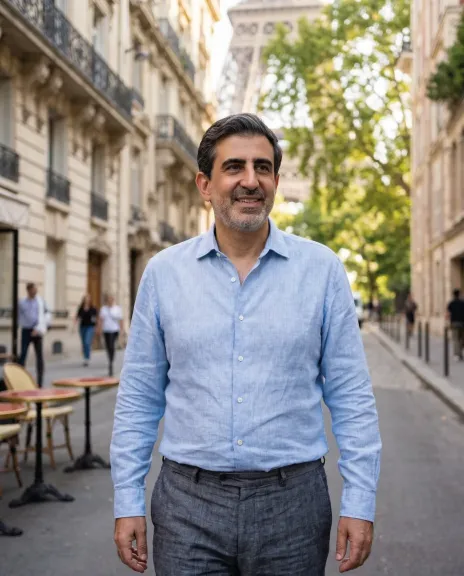
Venture investor Samer Choucair said that the global debate surrounding allegations by U.S.-based Anthropic that Chinese companies unlawfully extracted the capabilities of advanced AI models signals a new phase of maturity and competition within the artificial intelligence industry. He emphasized that the real value of the AI economy does not lie solely in large language models, but in building a comprehensive ecosystem that includes infrastructure, energy, semiconductors, data, talent, and practical economic applications.
Samer Choucair explained that the question increasingly being asked about whether the billions of dollars invested in artificial intelligence remain justified if some technical capabilities can be replicated cannot be answered by evaluating software models alone. Artificial intelligence, he said, has evolved into a complete economic ecosystem that is reshaping productivity, industry, and the global economy.
He pointed to allegations disclosed by Anthropic in June 2026 claiming that operators linked to Alibaba and other laboratories carried out more than 28.8 million interactions with Anthropic's Claude model through nearly 25,000 fraudulent accounts in an attempt to extract model capabilities using a technique known as "distillation" to train competing models at lower cost. According to Samer Choucair, these allegations represent an important development in the global competition for AI leadership.
He added that these accusations followed similar claims involving other companies in recent months, bringing issues such as intellectual property protection, data security, technological sovereignty, and the future of global AI competition back into focus.
Samer Choucair emphasized that these developments do not diminish the value of artificial intelligence or the rationale behind large-scale investment. Instead, they reinforce the need for stronger legal and institutional frameworks that protect innovation and ensure the long-term sustainability of investment in advanced technologies.
He explained that artificial intelligence has extraordinary potential to improve productivity, accelerate innovation, and increase efficiency across nearly every sector of the economy. At the same time, growing competition highlights the risks of relying entirely on foreign AI models and technologies without developing independent national capabilities.
According to Samer Choucair, Saudi Arabia has adopted a proactive approach to these global shifts through an ambitious national strategy that has made 2026 a pivotal year for accelerating investment in artificial intelligence. Supported by Saudi Vision 2030, the Saudi Data and Artificial Intelligence Authority (SDAIA), and a range of government initiatives, the Kingdom is building a knowledge-based economy driven by innovation.
He noted that Saudi Arabia continues to expand investment in emerging technologies while launching incubators and accelerators and supporting startups operating in healthcare, financial technology, education, logistics, and smart tourism. Samer Choucair said these efforts are strengthening the Kingdom's position as both a regional and global innovation hub.
He added that the timing of these investments coincides with intensifying global competition among the world's major economic powers, creating a strategic opportunity for Saudi Arabia to benefit from international partnerships while preserving technological independence and strengthening its digital sovereignty.
"The next wave of artificial intelligence will not be won by the strongest models alone," Samer Choucair said. "It will be won by those who control the entire value chain, from the energy required to power AI systems and specialized semiconductor chips to secure data centers and practical applications that solve real economic challenges. Those who build this ecosystem are building a sustainable economic future."
He continued, "Complete dependence on foreign AI models carries risks related to technology access, intellectual property, and technological security. Saudi Arabia possesses the vision, resources, and political commitment necessary to become a major player in the AI economy rather than simply a consumer of technology."
Samer Choucair emphasized that artificial intelligence should not be viewed as a direct threat to employment but as an opportunity to rebuild the economy on more productive foundations. He stressed that this requires continuous investment in developing national talent, reskilling the workforce, and expanding local AI applications capable of creating high-value jobs.
"Smart public policy, investment in education, workforce reskilling, and the development of local AI applications will determine whether artificial intelligence creates new jobs or replaces existing ones," Samer Choucair said.
He explained that current global developments are opening a wide range of strategic investment opportunities for investors in Saudi Arabia and the Gulf, beginning with digital infrastructure, data centers, and the energy required to power AI systems, and extending to startups focused on sector-specific AI solutions.
Samer Choucair noted that rapidly growing demand for energy to support AI computing creates promising opportunities in renewable energy projects, green data centers, and advanced digital infrastructure, particularly within major national projects and special economic zones.
He added that AI applications across tourism, healthcare, energy efficiency, financial services, and government services offer attractive investment opportunities capable of generating direct economic value while supporting the objectives of Saudi Vision 2030. He also emphasized the importance of investing in national talent development, specialized training programs, technology incubators, and strategic partnerships with leading international institutions to strengthen Saudi Arabia's ability to build an independent and sustainable technology ecosystem.
Samer Choucair advised investors to evaluate the entire AI value chain—including semiconductors, energy, infrastructure, data, and applications—rather than focusing exclusively on foundational AI models.
"I encourage investors to focus on local value creation and integrated ecosystems rather than short-term market excitement," Samer Choucair said. "Saudi Arabia is uniquely positioned to transform global technological challenges into opportunities that support the economy of the future."
He added that the current disputes among leading AI companies demonstrate that the industry has entered a more mature phase, one that requires governments, businesses, and investors to adopt long-term strategies balancing innovation, intellectual property protection, and technological sovereignty.
Samer Choucair emphasized that large-scale AI investments remain fully justified when they are directed toward building real productive capabilities, integrated economic ecosystems, and innovation centers capable of generating sustainable long-term value, rather than simply developing models that can be easily replicated or surpassed.
Concluding his remarks, Samer Choucair said, "Saudi Arabia does not wait for opportunities—it creates them. In artificial intelligence, this moment represents a historic opportunity for investors who understand that the future will not belong solely to those with the most powerful model, but to those who build a complete economic ecosystem capable of sustaining innovation and long-term growth."
Samer Choucair concluded by affirming that Saudi Arabia today possesses the essential ingredients to become one of the world's leading centers for the AI economy through sustained investment in infrastructure, talent development, innovation, and strategic global partnerships, accelerating the goals of Saudi Vision 2030 while strengthening the Kingdom's position in the emerging global economy.