
Samer Choucair: Linking Cryptocurrency to Political Influence Raises the Cost of Capital
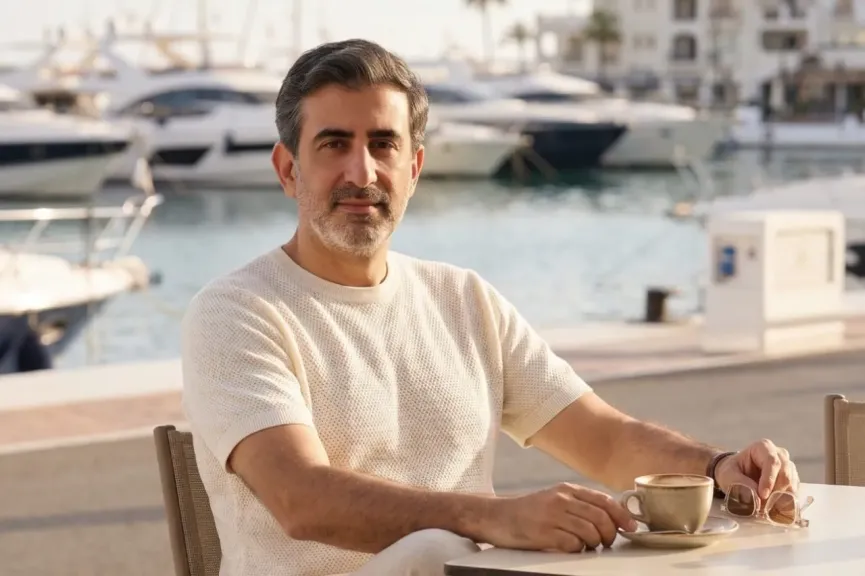
Samer Choucair: Linking Cryptocurrency to Political Influence Raises the Cost of Capital
Entrepreneur Samer Choucair said recent developments in cryptocurrency markets, which have revealed an unprecedented intersection between political influence and digital assets, represent an important turning point in how institutional investors assess risks and opportunities across global markets.
He noted that the growing relationship between politics and cryptocurrency is reshaping the risk landscape in alternative-asset markets and imposing new standards on capital-allocation decisions.
Samer Choucair’s comments followed financial disclosures indicating that US President Donald Trump generated more than $1.4 billion from cryptocurrency-related activities during 2025, driven primarily by the World Liberty Financial project and the $TRUMP memecoin, following early investments of approximately $200 million by entrepreneur Justin Sun, founder of the Tron network.
The relationship later developed into a reciprocal legal dispute involving the freezing of digital tokens and competing defamation allegations.
Investors have viewed the conflict as a significant test of the governance of digital assets connected to political power, with direct implications for political-risk assessments, capital allocation, and liquidity trends in alternative-asset markets during 2026.
Samer Choucair explained that the digital-asset market is undergoing a structural transformation in its relationship with political authority, after returns generated through digital tokens and decentralized governance became a major source of income for one of the world’s most prominent political figures.
Official disclosures filed with the US Office of Government Ethics showed that more than $1.4 billion of Trump’s income in 2025 came from cryptocurrency-related ventures, significantly exceeding revenue from real estate and legal settlements.
Choucair added that Justin Sun played a central role in launching the project after investing more than $75 million in World Liberty Financial tokens and over $100 million in the $TRUMP memecoin, making him one of the project’s most prominent early investors.
These capital inflows helped transform a project that had initially struggled to raise $30 million into a token sale exceeding $550 million.
Samer Choucair noted that the partnership did not last. It developed into an open legal dispute after Sun filed a lawsuit in April 2026 accusing the company of freezing his assets through a blacklist function embedded in the smart contract.
The company responded with a countersuit alleging defamation and short selling, illustrating the fragility of business models combining political influence with digital liquidity.
Choucair emphasized that these developments are occurring as global markets reprice political risk across the digital-asset sector.
Following the optimism associated with Trump’s return to the White House and the administration’s more supportive position toward the cryptocurrency industry, investment institutions have begun recognizing that direct connections to political figures can materially increase operational and regulatory risks.
“Institutional investors no longer evaluate a digital project solely through trading volumes or expected returns,” Samer Choucair said.
“They also assess whether operational decision-making is sufficiently separated from direct political influence. Any structure granting a family or inner circle 75% of token-sale profits creates a structural conflict that is difficult to ignore in long-term capital-allocation models.”
Choucair added that allegations concerning the freezing of tokens—which Justin Sun said had generated more than $60 million in unrealized losses during an earlier period—raise fundamental questions about the meaning of decentralization when project administrators retain the authority to freeze assets.
In his assessment of investor trends, Samer Choucair explained that the case has prompted many sovereign wealth funds and asset managers to reconsider projects that rely on political legitimacy as a primary source of value.
Sun’s investment initially gave the project considerable market credibility, but that credibility proved vulnerable once the balance of interests shifted.
Choucair added that the legal dispute affected liquidity in WLFI tokens during certain trading periods and revived concerns about concentrated insider ownership, particularly given reports that members of the Trump family hold a controlling interest amounting to tens of billions of tokens.
“Markets are now pricing not only regulatory risk, but also political counterparty risk,” Samer Choucair said.
“When the project’s largest financial supporter becomes a party to litigation against it, the cost of capital rises for any similar venture in the future. This pushes institutions toward digital assets supported by more transparent and independent governance.”
Choucair noted that these developments have also accelerated the movement of institutional liquidity toward regulated infrastructure, including licensed trading platforms and exchange-traded funds linked to Bitcoin and Ethereum, and away from tokens associated with political figures.
They have also reopened the debate surrounding stablecoins and decentralized finance when centralized asset-freezing mechanisms remain in place.
Addressing the implications for Gulf economies, Samer Choucair said Saudi Arabia offers a different model under Vision 2030, based on developing a competitive financial and technology sector capable of attracting foreign investment into financial technology and artificial intelligence.
This model requires governance structures that clearly separate entrepreneurial initiatives from political support.
He added that the World Liberty Financial experience provides an important lesson about the risks of relying on political sponsors as a primary source of liquidity, compared with the importance of building platforms founded on institutional transparency and clear regulation.
“The strongest opportunities in the Gulf digital economy lie in regulated infrastructure and solutions supporting economic diversification, not in speculation connected to political cycles,” Samer Choucair said.
“Investors focused on long-term value will seek projects with independent operating revenue, auditable governance, and the ability to withstand changes in political influence.”
Choucair emphasized that this approach is aligned with Saudi Arabia’s National Investment Strategy and the Public Investment Fund, which favour partnerships that promote technology transfer and create high-quality employment rather than highly volatile exposure to memecoin markets.
Samer Choucair explained that the principal future risks fall into three categories.
The first is the possibility of stricter international regulation of digital assets connected to government officials. The second is declining retail-investor confidence in projects where profits are concentrated among insiders. The third is the movement of institutional liquidity toward more stable asset categories within the digital sector itself.
He noted that the crisis creates opportunities for platforms capable of demonstrating governance independence and developing effective tools to manage political counterparty risk.
Choucair expects continued volatility in tokens connected to political figures, while digital assets with practical applications in payments, trade finance, and supply chains are likely to become increasingly attractive.
He added that the resolution of Justin Sun’s earlier cases involving the US Securities and Exchange Commission under the current administration remains closely monitored by analysts as an indicator of the relationship between politics and regulatory enforcement.
Concluding his remarks, Samer Choucair said the issue is likely to trigger a broad repricing of political risk within alternative-asset portfolios during the coming period.
Investment institutions are increasingly recognizing that political connections, once viewed as a source of regulatory protection, can become a source of structural volatility.
“Institutional capital always seeks clarity,” Samer Choucair concluded.
“When legal conflict becomes the defining feature of the relationship between an investor and political authority, the message to markets is clear: sustainable value is built on structures, not personalities. This principle will shape capital-allocation decisions in 2026 and beyond.”
Choucair added that investors incorporating this analysis into their investment models will be better positioned to identify genuine opportunities in the digital economy, separate them from political noise, and align their portfolios with the priorities of long-term capital.