
The New Gilded Age: A Widening Chasm Between a Soaring Few and a Struggling Many
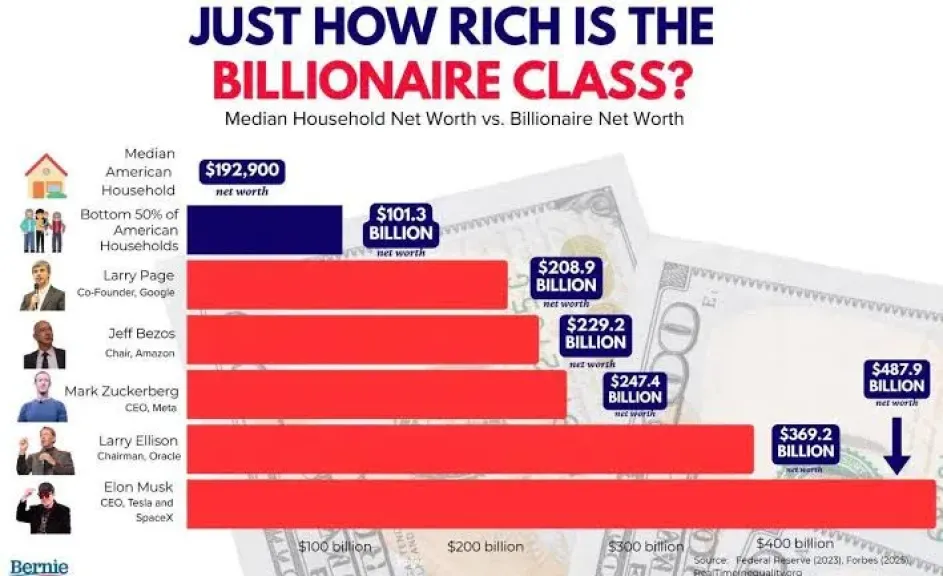
The global economy has never been richer. And yet, for billions of people, the basics of a secure life, a home, healthcare, enough food, feel further out of reach with each passing year. This is the paradox defining 2026: as billionaire fortunes climb toward record after record, ordinary working households are finding that wages no longer stretch to cover the essentials. The gap is not merely large; by several measures, it is the widest the modern world has ever recorded.
The numbers at the top are staggering. According to the World Inequality Report 2026, the global top 10 percent now captures 53 percent of all income and owns 75 percent of all personal wealth, while the bottom half of humanity, roughly four billion people, receives just 8 percent of income and holds a mere 2 percent of wealth. The concentration grows more extreme the higher you look. A tiny group of around 56,000 individuals, the top 0.001 percent, now holds three times more wealth than the entire bottom half of the world combined. Since the mid-1990s, the fortunes of billionaires and centi-millionaires have grown at roughly twice the rate of the bottom half.
The United States sits at the sharp end of this trend. It saw the largest expansion of its billionaire class in 2025, with the number of American billionaires rising from 835 to 924, meaning the country is now home to nearly a third of the world's billionaires. As of the start of 2026, the collective net worth of America's top 12 billionaires surpassed $2.7 trillion, a figure that has more than quadrupled since early 2020. Economist Paul Krugman has noted that today's top American fortunes represent a larger share of national wealth and output than they did during the original Gilded Age, the era of robber barons that the term was coined to describe.
While those at the summit accumulate wealth at breathtaking speed, progress for everyone else has stalled. Globally, the number of people living in poverty has barely changed since 1990, despite decades of economic growth. In the United States, the world's largest economy, 35.9 million people lived in poverty in 2024, around 10.6 percent of the population. And the squeeze is tightening even for those above the poverty line: recent pay gains have favored higher earners, with wages for high and middle-income workers rising 3 percent in a recent year compared to just 1.5 percent for low-income households, a reversal of the early pandemic pattern.
The result is what some economists call a "K-shaped" economy, where the experience of prosperity splits sharply depending on where you stand. The data can look strong at the top line, with solid GDP growth and a healthy stock market, even as millions feel they are falling behind. As one wealth-management executive put it, this disconnect is "why the economy can look strong in the data while millions of people feel like they're falling behind," with most middle and lower-income households struggling to afford homeownership or even basic necessities. Notably, the alarm is being sounded not only by activists but by billionaires themselves, with figures like Ray Dalio warning that the widening gap is becoming unsustainable.
This concentration of wealth increasingly translates into concentrated political power, which many analysts see as the deeper danger. Oxfam's 2026 report argues that billionaires are now thousands of times more likely to hold political office than ordinary people, and in the US, analysis found that 100 billionaire families accounted for 16.5 percent of all political contributions in the 2024 election, up from a negligible share in 2000. When the wealthiest can shape the rules, including the tax rules, the cycle tends to reinforce itself. Researchers note that tax progressivity often collapses at the very top, where billionaires can end up paying proportionally less than ordinary workers, draining public coffers of resources needed for education, healthcare, and other shared goods.
Crucially, the authors of the World Inequality Report insist this state of affairs is not inevitable, framing it instead as the product of choices. Extreme inequality, they argue, results from rules that were chosen: rules about what gets taxed, which public goods receive investment, and who has access to capital. History supports the point. The original Gilded Age was followed by reforms, the New Deal, post-war social programs, that built a broader middle class. Economists across the spectrum, including Nobel laureate Joseph Stiglitz, point to familiar tools: progressive taxation, strong social investment, fair labor standards. A modest global minimum tax on extreme wealth, the report estimates, could raise hundreds of billions annually while touching only a sliver of the population.
For now, though, the trajectory points upward for the few and sideways for the many, with analysts predicting the world's first trillionaire could emerge as soon as 2027. Whether societies summon the political will to bend that curve, as they have before, remains the defining economic question of the decade.