
The Trillion-Dollar Chasm: Inside the Wealth Gap Between Elon Musk and Jeff Bezos
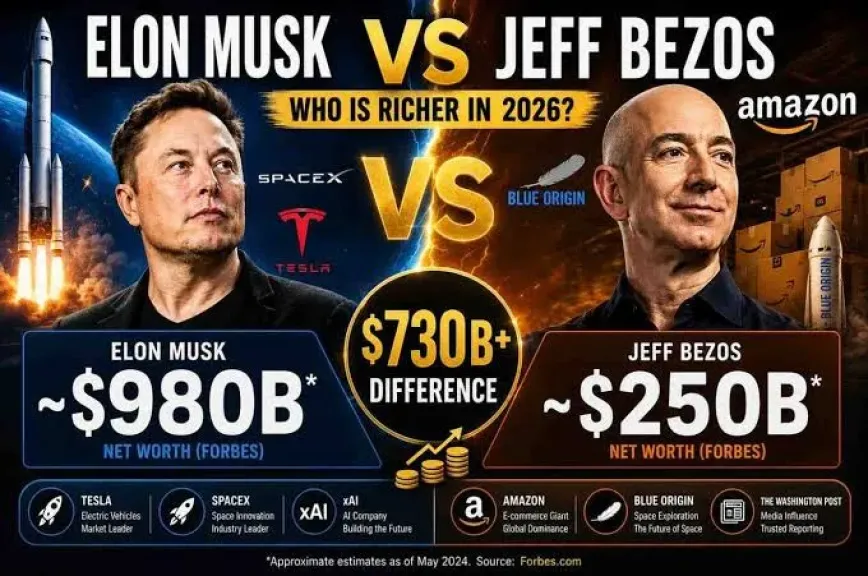
For two decades, Elon Musk and Jeff Bezos circled each other as near-equals—rival rocketeers, rival visionaries, rival claimants to the title of world's richest man. In 2026, that rivalry ended. Not with a narrow victory, but with a chasm so vast it strains comprehension.
The defining moment arrived on a single day. When SpaceX went public on June 12, 2026, Musk became the first person in history to hold a net worth exceeding $1 trillion. The offering repriced his roughly 42% stake in the rocket company, and combined with his Tesla, xAI, and X holdings, it launched him into territory no human being had ever occupied.
The figures are staggering. By late June 2026, Musk's fortune hovered around $950 billion, built primarily on his stakes in SpaceX and Tesla. Bezos—a man whose name was synonymous with extreme wealth for the better part of a decade—trailed at roughly $247 billion, with nearly all of it bound to Amazon stock. The distance between them: close to $700 billion. To put that another way, the gap alone dwarfs the entire net worth of any other person alive.
Consider the perspective this demands. Bezos's fortune sits more than $800 billion behind Musk's—a sum roughly equal to the combined wealth of the ten richest people on Earth just a few years ago. The reality is so distorted that, as one widely circulated observation captured it, the average American is now closer to Jeff Bezos in net worth than Bezos is to Elon Musk. The human mind resists numbers this large, but a simple comparison cuts through: a billion seconds is nearly 32 years; a trillion seconds is more than 31,000 years. That is the difference we are talking about.
It was not always this way. For years, Musk, Bernard Arnault, and Bezos traded the top spots among the world's richest people, with Bezos reigning on Amazon's relentless ascent. What broke the deadlock was the eruption in value of Musk's private empire. The bulk of his lead flows from SpaceX's extraordinary valuation, paired with his Tesla holdings—the IPO priced the rocket company near $1.77 trillion before shares opened even higher.
Yet for all its drama, this is paper wealth, not cash in a vault—a crucial distinction. Billionaire net-worth figures swing rapidly with stock prices, private valuations, ownership structures, and shifting analyst methods. Musk's own number proved the point with breathtaking volatility: past $1 trillion at the IPO, briefly soaring toward $1.4 trillion days later, then sliding back beneath the trillion mark within weeks. Bezos's fortune, tethered to a single mature company, moves with far more restraint.
The divide, however, measures more than money—it captures two fundamentally different bets on the future. Musk commands the lead in wealth, space, public visibility, and emerging technology, while Bezos retains the upper hand in e-commerce, cloud infrastructure, and corporate durability. And Bezos is hardly conceding the field. Blue Origin continues building rockets and lunar hardware for NASA, while Amazon's satellite ambitions steadily take shape to rival Starlink. One is the hare, sprinting; the other the tortoise, still moving with patience and deep reserves.
Finally, the milestone has thrust a larger question into the spotlight. At its peak, Musk's wealth equaled roughly 3% of US GDP—a greater share of the American economy than John D. Rockefeller commanded when he became the nation's first billionaire over a century ago. Lawmakers seized on the moment to renew calls for a wealth tax. Whatever side of that debate one lands on, the gulf between the world's two most famous entrepreneurs has ceased to be a contest. It has become a monument—to ambition, to risk, and to just how unevenly the modern economy crowns its winners.