
Too Good to Be True: The Cybertruck”s Rocky Road From Demo to Reality
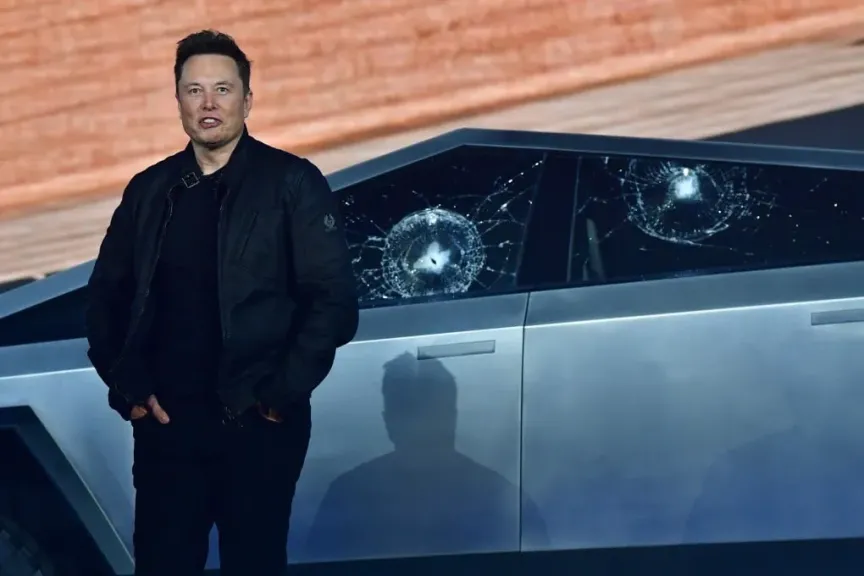
When Elon Musk unveiled the Tesla Cybertruck in November 2019, the world watched with a mixture of awe, confusion, and anticipation. The angular, stainless steel behemoth promised to revolutionize the pickup truck industry, blending futuristic design with extraordinary performance claims. But from the very moment it was introduced to the public, cracks began to show and what was meant to be a triumphant debut became one of the most memorable product launch stumbles in modern automotive history.
**The Demo That Went Wrong on Live Television**
The Cybertruck's unveiling event was meant to be a showcase of strength and innovation. Musk had hyped the truck's "Tesla Armor Glass" windows as virtually unbreakable, capable of withstanding serious impact without shattering. To prove the point, Tesla's lead designer Franz von Holzhausen hurled a steel ball at the driver's side window in front of a live audience and rolling cameras. The window shattered immediately. Visibly caught off guard, Musk attempted to recover by trying the rear window which also cracked on impact. The audience fell into stunned silence before nervous laughter rippled through the room. Musk's reaction, a bewildered "Oh my God" followed by an attempt to brush past the moment, only added to the spectacle. The clip went viral within hours and became the defining image of the Cybertruck's introduction to the world.
**A Design That Divided Opinion**
Beyond the broken windows, the Cybertruck's design itself proved deeply polarizing. Unlike any pickup truck that had come before it, the vehicle's sharp, geometric body looked less like a consumer product and more like a prop from a science fiction film. Musk and Tesla framed this as bold and visionary, but many industry observers and potential buyers were not convinced. Traditional truck buyers, who represent one of the most loyal and brand conscious segments in the automotive market, were largely unmoved. Questions arose almost immediately about practicality. How would a body made of ultra hard stainless steel hold up in real world use? Could it be repaired after a collision? Would it even fit in a standard garage or parking space? The answers were not reassuring.
**Years of Delays and Broken Promises**
The problems did not stop at the launch event. Tesla promised that the Cybertruck would enter production in 2021, a deadline that came and went without a single vehicle reaching a customer. The timeline shifted repeatedly in 2022 and then again in 2023 as Tesla cited supply chain challenges, manufacturing complexities, and the unique difficulties of working with stainless steel at scale. Each delay chipped away at the excitement that had surrounded the truck's announcement and raised serious doubts about whether Tesla could deliver on its ambitious promises. Reservation holders who had placed deposits years earlier found themselves waiting indefinitely, with little transparency about when or whether their vehicles would arrive.
*When It Finally Arrived, the Problems Continued**
When the Cybertruck finally began deliveries in late 2023, the relief was short lived. Real world owners quickly began reporting a troubling range of issues. The stainless steel exterior, while visually striking, proved susceptible to rust and corrosion, a damaging irony for a vehicle that had been marketed on the basis of its toughness. Reports emerged of body panels warping, gaps in the bodywork, and a ride quality that many described as stiff and uncomfortable for everyday use. The truck's turning radius was notoriously wide, making it awkward to maneuver in urban environments, parking lots, and tight spaces that ordinary pickup trucks handle with ease.
*Recalls and Safety Concerns**
Perhaps most damaging to the Cybertruck's reputation were the safety related recalls that followed its launch. Tesla issued multiple recalls in a relatively short period, addressing issues ranging from faulty accelerator pedals to problems with the windshield wiper system. One recall involved an accelerator pedal cover that could become dislodged and trap the pedal in a fully pressed position, a serious safety hazard that affected a significant number of vehicles. For a truck that had been positioned as the future of transportation, the stream of recall notices painted a very different picture, one of a product that had been rushed to market before it was truly ready.
**The Gap Between Vision and Reality**
Elon Musk has built his career on selling the future, and few have done it more compellingly. But the Cybertruck stands as a cautionary tale about the distance between a bold vision and a finished product. The promises made on that stage in 2019 set expectations so high that even a competent vehicle would have struggled to meet them. What arrived instead was a truck plagued by delays, design compromises, safety recalls, and real world limitations that its marketing had never prepared buyers for. The shattered window at the launch event turned out to be more than an embarrassing accident. It was a preview of everything that was to come.
The Cybertruck is not without its admirers, and Tesla continues to refine and improve the vehicle with each passing month. But the story of its journey from concept to consumer is a reminder that spectacle and substance are not the same thing. In the race to be first and to be bold, the fundamentals of engineering, quality, and honest communication with customers should never take a back seat. The road ahead for the Cybertruck remains uncertain, but one thing is clear: the world will be watching closely, and this time, it will take more than a dramatic stage reveal to win back their trust.